
 Chios
is famous for its ship owners (think Onassis), beautiful countryside and the
fact that it is the only place in the world where Masticha (gum mastic) is produced. Masticha, is a bitter sweet resin used in
the production of tooth paste, liqueur, chewing gum, varnishes, color
TV sets, cosmetic creams and floor waxes. If you have ever chewed gum,
especially the more natural kind, you've probably tasted a part of Chios
Island. Masticha comes from the Lentisk tree which is bushy and refuses
to yield masticha when it is transplanted anywhere in the world even on
the island! In English the word masticate means to chew... go figure!
Chios
is famous for its ship owners (think Onassis), beautiful countryside and the
fact that it is the only place in the world where Masticha (gum mastic) is produced. Masticha, is a bitter sweet resin used in
the production of tooth paste, liqueur, chewing gum, varnishes, color
TV sets, cosmetic creams and floor waxes. If you have ever chewed gum,
especially the more natural kind, you've probably tasted a part of Chios
Island. Masticha comes from the Lentisk tree which is bushy and refuses
to yield masticha when it is transplanted anywhere in the world even on
the island! In English the word masticate means to chew... go figure!
Other island specialties are kopanitsi, a wonderful blue cheese, and the brown, wrinkled olive chourmades which means dates, (the eating kind). The island also produces good barrel wine.
 Chios Town
Chios Town (or Chora), like so many island towns in Greece was rebuilt after an earthquake.
The Nazis, during their WWII withdrawal, destroyed much of it. When you arrive by ferry, it doesn't look like a typical Greek Island capital.
There are "tall" (5 stories) ugly concrete buildings with American pool halls, high rise offices, apartment blocks and fast-food joints.
There are many sailors and all that they imply. Move past the waterfront area as quickly as you can!
The streets behind the waterfront are much nicer and more authentic.
Further back into the town itself, which is sister city to Genoa, Italy, you'll find more traditional charm.
 The Byzantine Fortress contains most of Old Chios and is to the right of the harbor. Built
upon the ruins of the Macedonian Castle, it was destroyed by the Persian
Mithridates. The southwestern entrance, Porta Maggiora, is the most interesting and best preserved entrance to the kastro.
The Byzantine Fortress contains most of Old Chios and is to the right of the harbor. Built
upon the ruins of the Macedonian Castle, it was destroyed by the Persian
Mithridates. The southwestern entrance, Porta Maggiora, is the most interesting and best preserved entrance to the kastro.
Most of what survives from the Turkish occupation is within the fortress. There's a ruined mosque, a Turkish cemetery, and a very small prison. The Kastro Justinian Museum contains detached frescoes, carvings and early Christian mosaics.
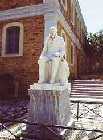 The
town
central square Plastira or Platea Vournakiou is
a tree lined expanse with cafes and pastry shops. The Statue of Bishop
Plato Fragiadis stand to one side. Within the city gardens, just
behind, is the statue of Kanaris, Hero of the Revolution.
The
town
central square Plastira or Platea Vournakiou is
a tree lined expanse with cafes and pastry shops. The Statue of Bishop
Plato Fragiadis stand to one side. Within the city gardens, just
behind, is the statue of Kanaris, Hero of the Revolution.
A Mosque is within the square and marked with the Turga of the Sutlan (swirling thumbprint) and is a mark of the islands' one-time special status. The Mosque houses the Byzantine Museum (hours: 10-1, Sun 10-3, closed Mon) with a collection of Art and religious icons. The Homerium, on the square's south, serves as the Art Exhibition Hall and community center.

Why not enjoy Harry's Free Musical Compositions while you read this site? (opens seperately)
©Harry's Greece Travel Guides