
 Harry's Note: I am pleased to announce collaboration with renowned scholar and author John L. Tomkinson.
Mr. Tomkinson is the author of many books about Greece (and other subjects) and he has agreed to provide for us, some of his insights, on this page, as well as others throughout my sites.
True lovers of Greece will be well rewarded by obtaining some of his very reasonably priced editions which are only available internationally, direct from the publisher.
His series Greece: Beyond the Guidebooks has been a source of inspiration to me personally. Major credit cards accepted.
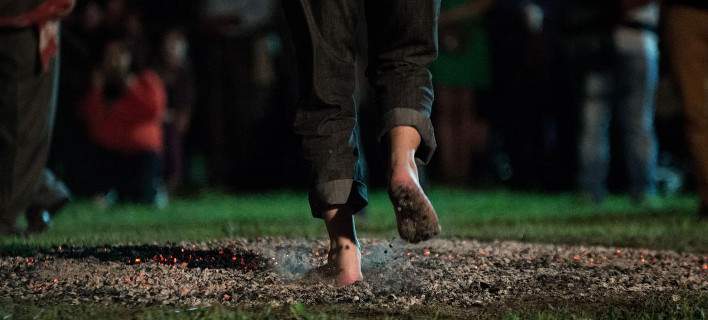
The Anastenaria is a traditional ritual of fire walking which dates back to pagan times. Barefoot villagers of Ayia Eleni near Serres, Langada near Thessaloniki, and other places, annually walk over hot coals. The details of the ritual vary slightly from place to place.
T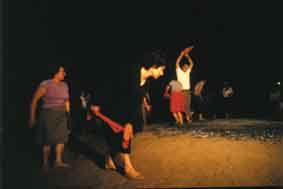 he communities which celebrate the Anastenaria are descendants
of Greek refugees from Eastern Thrace who arrived in Macedonia following
the Balkan Wars and the exchange of populations in 1923. Each village community
of Anastenarides is headed by a “group of twelve” of which the
large majority are women. They meet in a special building, or in the room
of a house set aside for the purpose, called a konaki. Here on a shelf are
kept the special icons of SS Constantine and Helen. Each has a handle so
that it can be carried in processions and dances, is hung with small bells,
decorated with “sacred knots” made from kerchiefs, and is covered
with specially made cloth envelopes.
he communities which celebrate the Anastenaria are descendants
of Greek refugees from Eastern Thrace who arrived in Macedonia following
the Balkan Wars and the exchange of populations in 1923. Each village community
of Anastenarides is headed by a “group of twelve” of which the
large majority are women. They meet in a special building, or in the room
of a house set aside for the purpose, called a konaki. Here on a shelf are
kept the special icons of SS Constantine and Helen. Each has a handle so
that it can be carried in processions and dances, is hung with small bells,
decorated with “sacred knots” made from kerchiefs, and is covered
with specially made cloth envelopes.
 On the eve of the feast of Saints Constantine and Helen
the Anastenarides gather in the konaki, where the participants take part
in dances during which the Anastenarides believe that they are “seized”
by the saint, and enter a state of trance.
On the eve of the feast of Saints Constantine and Helen
the Anastenarides gather in the konaki, where the participants take part
in dances during which the Anastenarides believe that they are “seized”
by the saint, and enter a state of trance.
On the morning of the saint's day an animal is sacrificed.
After darkness falls a fire is lit, the ashes spread over the ground and the Anastenarides dance once more. When they are ready, the move to the place of the fire and dance over the hot coals.
According to the Anastenarides themselves, the origin of the ritual lies in a fire which took place at Kosti, near the Black Sea in the thirteenth century. One night the church of Saint Constantine caught fire, and as it burned the people heard cries coming from the flames. It was the icons calling out for aid. Some villagers ran into the building and rescued them, neither the icons not their saviours being burned. Since that time, the Anastenaria has been held to celebrate their delivery.
This story is similar to many invented to “explain” customs
of unknown origin found across Greece.
For various reasons, scholars are more inclined to the view that it is
the survival of a a very ancient Thracian Dionysian ritual which was later
given a superficial Christian interpretation.
Read more about the Anastenarides and their strange ritual http://www.anagnosis.gr
Read more about Greek folk rituals in "Festive Greece: A Calendar of Tradition" http://www.anagnosis.gr/Festive_Greece.htm
Photos copyright Pamela Browne.

Why not enjoy Harry's Free Musical Compositions while you read this site? (opens seperately)
©Harry's Greece Travel Guides