
 The approach from the
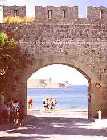
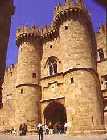
sea is best, with its massive walls rising up from the water, the Palace of the Grand Master, the
minarets and the waterfront with its arcades. Windmills from the 14th century add to the picture. There are three harbors (the
smallest of which is Mandraki, which caters to yachts, excursion boats and smaller ferries). and eleven gates into
the city, one of the most impressive being the Gate of Emery d'Amboise/Pili Ambouaz near the Palace of the Grand Masters,
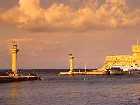
built in 1512.. A lighthouse guards the entrance, along with the fort of Ahios Nikolaos, built 1460s against Ottoman Turkish
attacks. By now it may have been converted into a naval museum. Where the famous Colossus may have stood are now a bronze
stag and doe. A chain crossed here (blocking the entrance)during the time of the Knights, with ships paying a 2% tax (based
on the value of their cargoes) to help the war effort. The walls are magnificent, but accessible only via guided tours
(people usually meet for this in front of the Palace of the Grand Masters). You can most likely find a schedule easily). Four
Grand Masters constructed the walls on top of the older Byzantine walls. They extend 4km and are on the average 38feet thick
. In addition, they were curved to deflect missiles aimed at them, and surrounded by a dry moat 100 feet wide. The Knights
were assigned the defense of their respective bastions and towers according to nationality , with the exception of the
Italians, who were put in charge of the Knights' fleet.
The approach from the
sea is best, with its massive walls rising up from the water, the Palace of the Grand Master, the
minarets and the waterfront with its arcades. Windmills from the 14th century add to the picture. There are three harbors (the
smallest of which is Mandraki, which caters to yachts, excursion boats and smaller ferries). and eleven gates into
the city, one of the most impressive being the Gate of Emery d'Amboise/Pili Ambouaz near the Palace of the Grand Masters,
built in 1512.. A lighthouse guards the entrance, along with the fort of Ahios Nikolaos, built 1460s against Ottoman Turkish
attacks. By now it may have been converted into a naval museum. Where the famous Colossus may have stood are now a bronze
stag and doe. A chain crossed here (blocking the entrance)during the time of the Knights, with ships paying a 2% tax (based
on the value of their cargoes) to help the war effort. The walls are magnificent, but accessible only via guided tours
(people usually meet for this in front of the Palace of the Grand Masters). You can most likely find a schedule easily). Four
Grand Masters constructed the walls on top of the older Byzantine walls. They extend 4km and are on the average 38feet thick
. In addition, they were curved to deflect missiles aimed at them, and surrounded by a dry moat 100 feet wide. The Knights
were assigned the defense of their respective bastions and towers according to nationality , with the exception of the
Italians, who were put in charge of the Knights' fleet.
 The Old Town
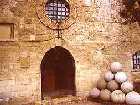
(Palaia Poli) is a fascinating place to wander around, with its pebble pavements ('hokhlaki'), archways,
ochre and blue walls of sandstone and limestone, and its oleanders, bougainvillea and hibiscus. The Italians, if they hadn't
lost the war, would have widened all the streets for cars and built a road encircling it (a frontage road). Such things can
never happen now that it is designated a UNESCO World Heritage Site, which also provided for restoration of historical
structures (and general infrastructure) as well as the burying of phone and electrical power lines. If you enter via the
Gate d'Amboise, you 'll soon be in the Collachium, which was a place of retreat for the Knights in the event of the outer
wall being taken by an enemy.
The Old Town
(Palaia Poli) is a fascinating place to wander around, with its pebble pavements ('hokhlaki'), archways,
ochre and blue walls of sandstone and limestone, and its oleanders, bougainvillea and hibiscus. The Italians, if they hadn't
lost the war, would have widened all the streets for cars and built a road encircling it (a frontage road). Such things can
never happen now that it is designated a UNESCO World Heritage Site, which also provided for restoration of historical
structures (and general infrastructure) as well as the burying of phone and electrical power lines. If you enter via the
Gate d'Amboise, you 'll soon be in the Collachium, which was a place of retreat for the Knights in the event of the outer
wall being taken by an enemy.
More about Rhodes page: 1 | 2 | 3 | 4 | 5 | 6 | 7 | 8 | 9 | 10 | 11 | 12 | 13 | 14 | 15 | 16 | 17 | 18

Why not enjoy Harry's Free Musical Compositions while you read this site? (opens seperately)
©Harry's Greece Travel Guides