
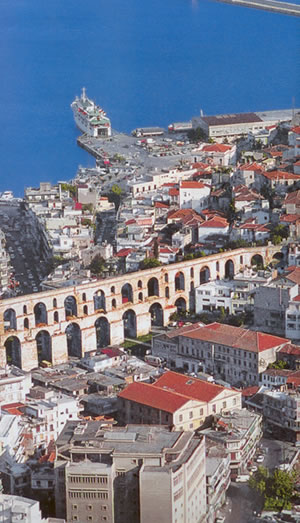
 Towards the shore from the citadel is the business center, occupying a depression in the land,
Kamares, the 16th
century aqueduct spanning it and the old town Palaia Poli, built to bring water to the kastro from local springs.
Towards the shore from the citadel is the business center, occupying a depression in the land,
Kamares, the 16th
century aqueduct spanning it and the old town Palaia Poli, built to bring water to the kastro from local springs.
It is the town's most prominent feature. Built on the Roman models, it has three tiers of arches.
To the north is Odhos Ellinikis Dhimokratias, with some streets that retain some old Turkish houses and shops, but most of these are gone. The Citadel is surrounded by well-preserved Byzantine walls, which re-used ancient masonry in its construction, was restored after earthquakes in 926 and again in the 1500s.
The Imaret is an elongated structure which overlooks the harbor at Poulidhou.
There are Arabic inscriptions over many of the doorways. The almshouse was endowed by Mehmet Ali, and members enjoyed free pilaf and exemption from military service; its local name was Tembel-Haneh (the 'lazy man's home'), though it was actually a hostel for theological students called 'softas', of which it could hold up to 300.
Though it had fallen into decay for decades, it was finally refurbished during the 1990s, and turned into a restaurant-bar (thus continuing its historic identity as eating-place, though no longer for free).
It is claimed that this building is the biggest Islamic public building in Europe. In 1969-61 excavations of the Imaret were carried out , uncovering a Sanctuary of the Parthenos, with ceramic finds from all over the Aegean.
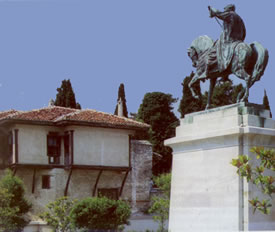 Mehmet Ali's Birthplace, in the Seraidaris Garden, is a fine Ottoman style house with excellent wood panelling
in
the reception rooms, cared for first by the Egyptian government and later by the Greeks.
Mehmet Ali's Birthplace, in the Seraidaris Garden, is a fine Ottoman style house with excellent wood panelling
in
the reception rooms, cared for first by the Egyptian government and later by the Greeks.
It is maintained as a public monument, with a caretaker in situ who will show you the house if you ring the bell. On the lower level are stable and kitchen; upstairs, the harem and the pasha's quarters, the harem with is fitted with moucharabies-wooden lattices which enable one to see without being seen.
There are good views from the garden surrounding the house. In the little square beyond it is a bronze equestrian statue of Ali by Dimitriadhis, below which is a belvedere with a view towards Thasos.
The local inhabitants swim off of the rocks on the east side of the peninsula. The remains of the Byzantine Kastro on the promontory is open Tues-Sun 8:30am-5pm with later hours during midsummer music and dance festivals , admission free. The kastro is near old houses, a mosque and baths and its walls offer a good view of the harbor.

Why not enjoy Harry's Free Musical Compositions while you read this site? (opens seperately)
©Harry's Greece Travel Guides