
 Two: the famous myths which have survived through the plays of Aeschylus, Sophocles and Euripides and which rival those of Mycenaea in their tragic aspects. The myths state that Thebes was founded by Cadmus (Kadmos) the Phoenician hero who came to Greece to look for his sister Europa who had been abducted by Zeus. Upon the advice of Apollo, Cadmus abandoned the search for his sister to found a city (Thebes) and had to overcome several tests in order to do so. One of these was the slaying of a dragon whose teeth fell out upon its death and as they fell to the ground they turned into giants which also needed to be killed (the Sparti or sown ones). The great families of Thebes subsequently claimed descent from these giants. Cadmus troubles were only begriming and were passed onto his children in various forms some of whom were ripped apart by hounds and others of which were torn apart by Maenads, still others were dragged by bulls and shot by the darts of Apollo and Artemis. But the best known myth of all is that of Oedipus, the son of Laius who successfully answered the riddles of the Sphinx. Oedipus unwittingly murdered his own father and married his mother and had children by her. The children came to bad ends too (Antigone).
 Thebes was additionally the reputed birthplace of the god Dionysus, demigod Hercules and poet Pindar.
Thebes also had a military unit called the Thebian Sacred Band which consisted of men bound together as very close associates.
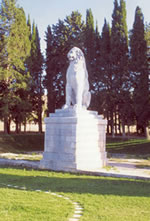
These mighty warriors had sworn to defend one another to the death which is exactly what they did when fighting for the Persians against the Athenians in the battle of Chairaeonia 490 BC. A monumental lion was erected in their memory near the battlefield. 245 skeletons along with their weapons were also discovered near by.
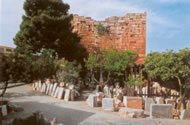 Modern Thebes or "Thiva" occupies a plateau (or Kadmus) which rises 60m above the surrounding plain and is 800m long and 400m wide. In 1853 and in 1893 the city was twice destroyed by earthquakes. It is surrounded by rock gullies sometimes littered with refuse. In recent years haphazard building have further obliterated what little remains of ancient Thebes. There are a few parts of the upper city to be seen but the best vestiges are to be found in the museum. Open daily in summer from 08:00 to 19:00 except Monday when it opens at noon Tel: 2262-27913. In winter it closes at 3pm and is closed on Monday. Right, part of a Frankish tower in modern Thebes.

Why not enjoy Harry's Free Musical Compositions while you read this site? (opens seperately)
©Harry's Greece Travel Guides