
 The Kitsos Makris Folk Art Center is at Afendouli 50 (Mon-Fri 8:30am-2pm, Sat 10-2;free), with paintings by the 'naïve' folk artist from Mytilini/Lesvos island who was called 'Theophilos' (see the Pilio Peninsula for details on the museum of his works in one of the villages there as well as in scattered places over the peninsula).
Another free museum is the Giorgio de Chirico Art Centre (Metamorfoseos 3 (Mon-Fri 10am-1pm and 6-9pm;Sat 10am-1pm;Sun 6-9pm). The works of a Volos-born Surrealist artist is featured here on the second floor.
In actual history, Volos' sizeable historic Jewish community was one of the larger ones in northern Greece (others including the communities in Ioannina in Epirus, Larissa in Thessaly, and Halkidha on Evia island).
Most of the Jews of Volos survived the Nazis, due to their integration into the local community, and others hid on Mount Pilio or joined the Resistance. There is a memorial in Volos to the 155 who died at the large square Platia Riga Fereou, the sculpted memorial donated to the city by a survivor.
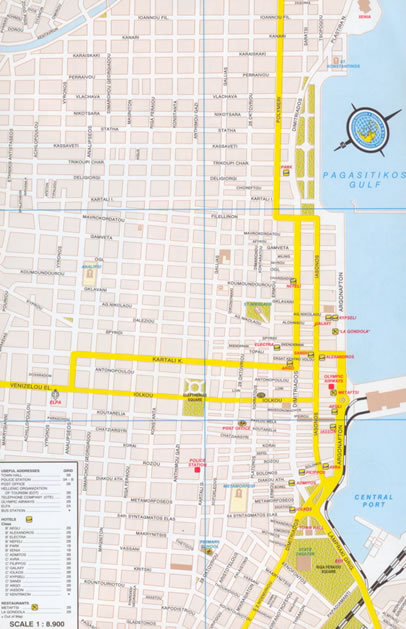
Beginning in 1947, modern Volos suffered a string of earthquakes, climaxing with two very serious ones in 1954 and 1955, which required its rebuilding, done in typical modern Greek concrete style, but n ear the Platia Riga Fereou are some of the more appealing sights in Volos-- the Fishing Harbor, the quayside with its Argonavton, the seaside boulevard where the evening 'volta' (community promenade) is enjoyed.
There is a model of the Argo near the Landing Stage, where boats leave for the Sporades.
Volos specializes in fine ouzeria (plural of 'ouzeri', though ouzo is not the only drink offered in them), with big varieties of mezedhes (plural of 'mezes' or appetizer). There are a string of these ouzeria along the waterfront esplanade, Argonavton. For Volos hotels in the area please click.

Why not enjoy Harry's Free Musical Compositions while you read this site? (opens seperately)
©Harry's Greece Travel Guides