
The Lassi Peninsula on which Argostoli sits has a few sandy beaches, disco bars and tavernas. It's traditional when visiting Kefallona to hike or bike around this tiny peninsula just north of the city. In its north there are Katavothres or swallow holes. Geologists poured 150 kilos of green die down the holes to see where the water emerged and found out fifteen days later across the island near Sami in the cave lakes of Melissani and Karavomylos.
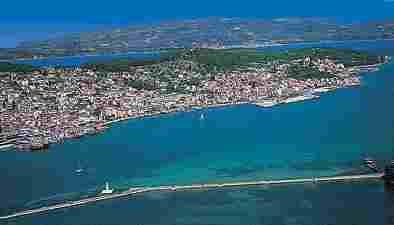 At the tip
of the peninsula is the Lighthouse of Aghio Theodori, a Doric Rotunda
funded by British High Commissioner Charles Napier. (picture above in the center)
At the tip
of the peninsula is the Lighthouse of Aghio Theodori, a Doric Rotunda
funded by British High Commissioner Charles Napier. (picture above in the center)
A brisk 15 minute walk inland will bring visitors to the WW II Memorial to the Italian soldiers who lost their lives fighting the Nazis. To the south of Argostoli are some wonderful beaches but commercialized with package tours–Plati Gialos and Makris Gialos. Here are two of the island's most luxurious hotels–The Mediterranee and the White Rocks.
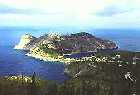 Once
past the overbuilt Piati Gialos and Makris Gialos, the coastal road breaks
free and the village of Minies appears. Minies holds the ruins of a 6th
Century BC Doric Temple. You are in wine country in this area. Continuing
on will bring you to Avithos beach with red sand, and a few amenities
near the village of Svoronata. Just across the water is the islet of Dias.
Once
past the overbuilt Piati Gialos and Makris Gialos, the coastal road breaks
free and the village of Minies appears. Minies holds the ruins of a 6th
Century BC Doric Temple. You are in wine country in this area. Continuing
on will bring you to Avithos beach with red sand, and a few amenities
near the village of Svoronata. Just across the water is the islet of Dias.
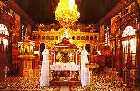 Some
of the oldest Olive trees on the island may found in the next village
of Domata where one tree can actually hold 20 people squeezed
within is hollow trunk. Olive trees can live a few thousand years.
Left, is the Church of the Virgin with some rather ostentatious
real gold baroque decor.
Some
of the oldest Olive trees on the island may found in the next village
of Domata where one tree can actually hold 20 people squeezed
within is hollow trunk. Olive trees can live a few thousand years.
Left, is the Church of the Virgin with some rather ostentatious
real gold baroque decor.
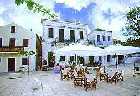 The
village of Kourkomelata is just about all new construction and
financed by Kefallonia's wealthy ship owner Mr. Vergotis. The next village Metaxata hosted Lord Byron for a few months while
he polished
up Don Juan and pondered his role as a member of the Greek Committee.
The
village of Kourkomelata is just about all new construction and
financed by Kefallonia's wealthy ship owner Mr. Vergotis. The next village Metaxata hosted Lord Byron for a few months while
he polished
up Don Juan and pondered his role as a member of the Greek Committee.
More Keffalonia Page: 1 | 2 | 3 | 4 | 5 | 6 | 7 | 8 | 9 | 10

Why not enjoy Harry's Free Musical Compositions while you read this site? (opens seperately)
©Harry's Greece Travel Guides