
 From
Argostoli, ferries make the trip
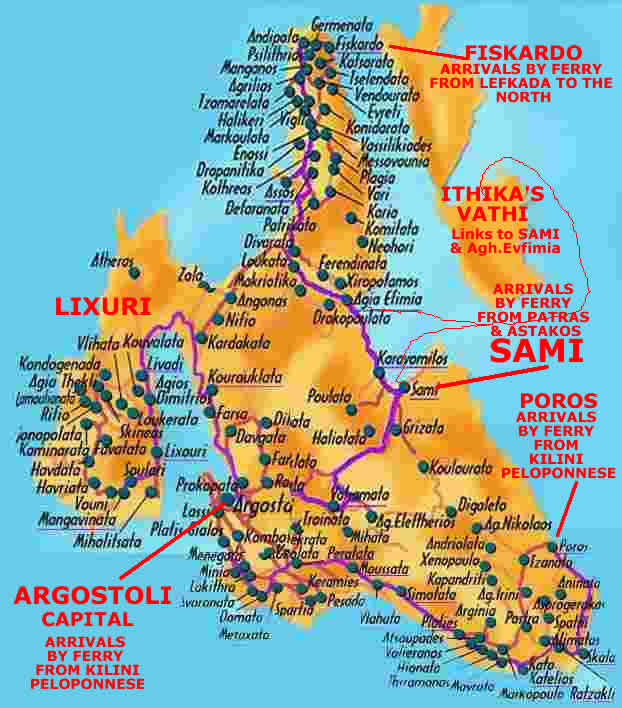
across the strait to Lixuri in about half an hour. Lixouri is known for its sense of humor and for being home to the poet and
satirist Andreas Laskaratos. Lixuri is now a working community,
the highlight of which is the elegant Iakovatos Mansion. An
icon museum and library, it is one of the few survivors of the earthquake
and offers a revealing look at how beautiful things must have been compared to
what they are today. On the west side of town, its hours are 8-1:30 Mon-Fri,
9:30-12:30 Sat.
From
Argostoli, ferries make the trip
across the strait to Lixuri in about half an hour. Lixouri is known for its sense of humor and for being home to the poet and
satirist Andreas Laskaratos. Lixuri is now a working community,
the highlight of which is the elegant Iakovatos Mansion. An
icon museum and library, it is one of the few survivors of the earthquake
and offers a revealing look at how beautiful things must have been compared to
what they are today. On the west side of town, its hours are 8-1:30 Mon-Fri,
9:30-12:30 Sat.
Some nice local, non built-up beaches are accessible from the peninsula: Aghios Spyridon, Michalitsata, Lepeda are all sandy. From the village of Mantzavinata a dirt road leads south to a long stretch of golden sand and Palliki's best known beach Xi which features umbrellas and tavernas.
 Just to its south is the now stationary Monolith of Kounopetra. It used to vibrate before the quake. To the north are the villages
of Kaminarata, Delaportata and Damoulinata.
The beach of Petani has nice white sand and almost is deserted. At the
northern tip of the peninsula is beach Aghios Spyridon II.
Just to its south is the now stationary Monolith of Kounopetra. It used to vibrate before the quake. To the north are the villages
of Kaminarata, Delaportata and Damoulinata.
The beach of Petani has nice white sand and almost is deserted. At the
northern tip of the peninsula is beach Aghios Spyridon II.
 There are loads of good
sandy, sheltered beaches to be found here in the lee of Megas Soros including Spartiaand
Pessada. Below Karavados village, Lourdata is the most popular and longest
beach. This beach is also beginning of the Nature Trial, funded by the WWF. A 2.5
hr walk which encompasses most of the island's fauna and passes the
ruined Monastery of St. Francis of Assis founded in 1218.
There are loads of good
sandy, sheltered beaches to be found here in the lee of Megas Soros including Spartiaand
Pessada. Below Karavados village, Lourdata is the most popular and longest
beach. This beach is also beginning of the Nature Trial, funded by the WWF. A 2.5
hr walk which encompasses most of the island's fauna and passes the
ruined Monastery of St. Francis of Assis founded in 1218.
Kato Kastelios is a small resort with a pretty beach curving along Mounda Bay. Just below Ratzakli village is Potamaki beach and a nesting place for protected loggerhead turtles. Please leave the turtles to themselves!
The village of Markopoulo, just inland, is the yearly scene of the appearance of thousands of harmless baby snakes with small crosses on their heads. The appear at the beginning of August and disappear into the church by the altar near the silver icon of the Panagia Fidon (Virgin of the Snakes). At least that's what they did before the quake. Now villagers pick them up to protect them from motorists and gawkers, put them in glass jars and after the service deposit them within the church, which was rebuilt in exactly the same spot as before. They disappear just as in pre-quake days. The unfaithful claim that the church is simply on the reptiles' migratory route, while the faithful point out that the snakes fail to appear when the island is in trouble such as the year of the earthquake (1953) and during the German occupation.
More Keffalonia Page: 1 | 2 | 3 | 4 | 5 | 6 | 7 | 8 | 9 | 10

Why not enjoy Harry's Free Musical Compositions while you read this site? (opens seperately)
©Harry's Greece Travel Guides