
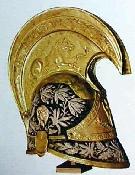
 The Benaki Archaeological Museum (Tues-Sun, 8:30am-3pm; 2euros admission) houses a well labelled collection of
Byzantine icons, relics of the War of Independence, tomb reliefs, sculptures and smaller items from the vicinity of the
city, a Roman mosaic, stone tools and Neolithic pottery from sites at Malthi; Mycenean, proto Geometric and Geometric
pottery, Mycenaean figurines from Karpofora, Achaean and Hellenistic pottery, late Classical, Hellenistic and Roman
statuary, late Byzantine icons, folk embroidery.
The Benaki Archaeological Museum (Tues-Sun, 8:30am-3pm; 2euros admission) houses a well labelled collection of
Byzantine icons, relics of the War of Independence, tomb reliefs, sculptures and smaller items from the vicinity of the
city, a Roman mosaic, stone tools and Neolithic pottery from sites at Malthi; Mycenean, proto Geometric and Geometric
pottery, Mycenaean figurines from Karpofora, Achaean and Hellenistic pottery, late Classical, Hellenistic and Roman
statuary, late Byzantine icons, folk embroidery.
The museum is housed in two old mansions belonging to the Benaki and Kyriakou familes and is near the church of Aghios Ioannis.
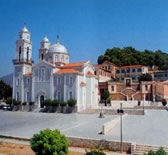 The Church of the Apostles, built by Andronicus Paleologue in 1317 has painting inside its dome (which is part of the
modern church), and a ruined Frankish bell tower. The Messinian Senate was formed in this church. Kalamata's Cathedral
was built in 1859, and has an icon allegedly by St. Luke, in its own museum, along with church vessels, gospels and
vestments. A Historical and Folk Museum, run by the Association for the Propagation of Learning, houses weapons,
household utensils, folk art and War of Independence paintings.
The People's Library contains 40,000 volumes.
The Church of the Apostles, built by Andronicus Paleologue in 1317 has painting inside its dome (which is part of the
modern church), and a ruined Frankish bell tower. The Messinian Senate was formed in this church. Kalamata's Cathedral
was built in 1859, and has an icon allegedly by St. Luke, in its own museum, along with church vessels, gospels and
vestments. A Historical and Folk Museum, run by the Association for the Propagation of Learning, houses weapons,
household utensils, folk art and War of Independence paintings.
The People's Library contains 40,000 volumes.
Below the kastro is the 18th century nunnery, which was the center of the silk-weaving industry, with both ancient and modern looms on display.
The city beach along Navarinou, a ten minute bus ride south from the city center, is not a beautiful one, and is often crowded. The harbor can be walked to in half an hour from the center, and there's a park with old steam engines and rolling stock at the open air Railway Museum.(free). Trains leave from Kalamata for Kyparissia.
Kalamata Page One | Two | Three | Four | Five

Why not enjoy Harry's Free Musical Compositions while you read this site? (opens seperately)
©Harry's Greece Travel Guides